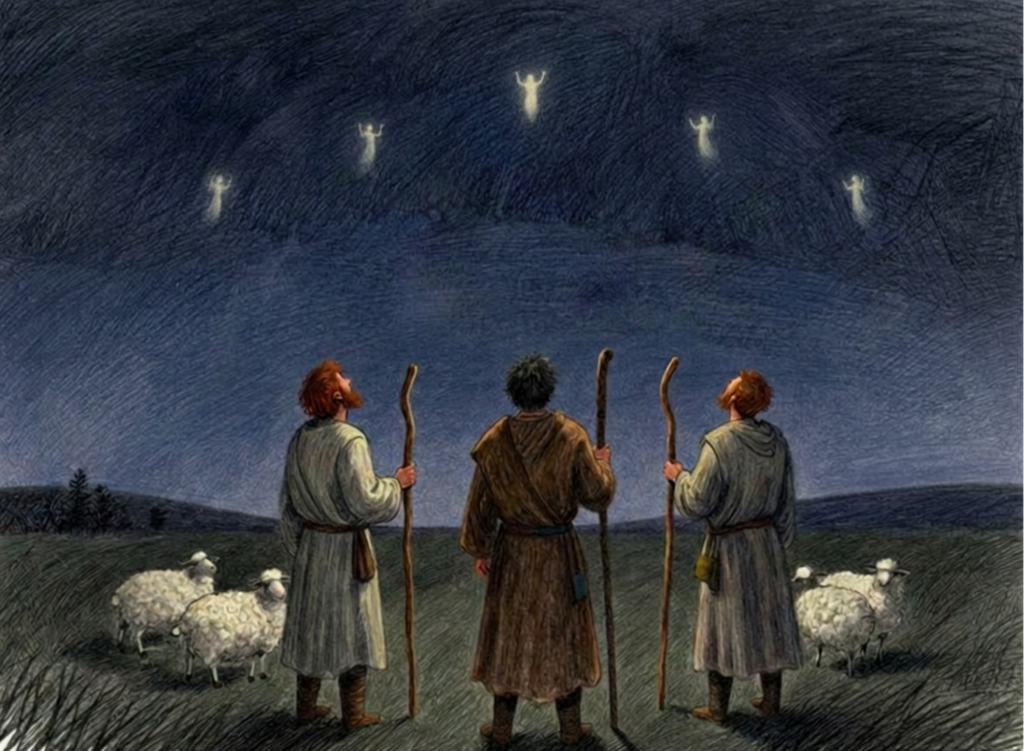
While Shepherds Watched Their Flocks is a beautiful and classic Christmas carol that works wonderfully on the harmonica. It has a gentle, storytelling quality that captures the peaceful night when the angels appeared to the shepherds.
One of the things I really like about this song on harmonica is how well the melody sits in the middle register. The notes flow naturally without requiring you to jump too high or too low on the harp, making it comfortable to play and easy to add expression. It’s a great song for practicing smooth note transitions and gentle phrasing.
One thing to try is adding a soft vibrato on the longer notes and keeping a steady rhythm on the quicker passages. You can also experiment with playing it softly for a serene feel or a bit stronger during the angel’s announcement for contrast.
- Difficulty: 2/5
- Harmonica Key: C Major
- Playing Position: 1st Position
- Length: Short
- Best for: Christmas church services, carol singing, family gatherings, and quiet holiday performances
Harmonica Tabs
VERSE 1 (same tab for all 6 verses)
 4      5   5       -4    4   6       -5  -5
While shep-herds watched their flocks at night

 5   5   6   6  -5    6
all seat-ed on the ground,

 5  -6  5  -5  5   -4   4    -3
The an-gel of the Lord came down

5   -4  4   4  -3   4
and glo-ry shown a-round.

 5   -4  4   4  -3   4
And glo-ry shown a-round.

VERSE 2
"Fear not," said he for mighty dread had seized their troubled mind
"glad tidings of great joy I bring to you and all mankind.

VERSE 3
"To you, in David's town, this day is born of David's line
a Savior, who is Christ the Lord; and this shall be the sign:

VERSE 4
"The heavenly babe you there shall find to human view displayed,
all simply wrapped in swaddling clothes and in a manger laid."

VERSE 5
Thus spoke the angel. Suddenly appeared a shining throng
of angels praising God, who thus addressed their joyful song:

VERSE 6
"All glory be to God on high, and to the earth be peace;
to those on whom his favor rests goodwill shall never cease.

Get more Christmas songs for the harmonica by clicking below (sponsored):
Easy Christmas Songs for the Harmonica: 25 Christmas Carols You Can Play Today
While Shepherds Watched Their Flocks — A Brief History
The Man Behind the Words
Unlike many Christmas carols whose authors are lost to history, we actually know who wrote this one — a Poet Laureate, no less. “While Shepherds Watched Their Flocks” was almost certainly written by Nahum Tate (1652–1715), who became Poet Laureate of the United Kingdom in 1692. Tate was the son of an Irish Protestant clergyman — his father was literally named Faithful Teate, which Nahum later softened to Tate. After graduating from Trinity College Dublin in 1672, Tate pursued a literary career in London, writing plays and poems. He even found success reworking neglected Shakespeare plays, and his version of King Lear — with a happy ending — was so popular that audiences preferred it to the original for about 150 years.
A Carol with Official Status
The hymn was first published in A Supplement to the New Version of Psalms in London in 1700. The original text was labeled “Song of the Angels at the Nativity of our Blessed Saviour” and was intended as a paraphrase of Luke 2:8–15.
What really sets this carol apart historically is its official standing: “While Shepherds Watched Their Flocks” was the only Christmas hymn the Anglican Church authorized to be sung, and before it was published, only the Psalms of David were allowed. That makes it one of the first “official” Christmas carols in English literature.
The Tunes — There Are Several
This is where the carol gets interesting. Unlike most hymns locked to one melody, this one has been sung to a surprising variety of tunes over the centuries.
The tune used most commonly today in Canada and the United Kingdom is “Winchester Old,” originally from a psalter published in 1592 but arranged by William Henry Monk sometime before 1874. It only became widely popular after the 1861 publication of the Church of England’s Hymns Ancient and Modern. Before that, the tune “Cranbrook” — written by a Canterbury shoe-maker named Thomas Clark and better known today as the melody for “On Ilkla Moor Baht ‘at” — was the preferred version across much of England. That version is still sung in some Yorkshire pubs.
In the US, the tune most widely paired with the carol is one adapted from a melody in the opera Siroë, King of Persia, composed by George Frideric Handel and first performed in 1728. No one is certain who married the words to that music, though editors of The New Oxford Book of Carols suspect it was American composer Lowell Mason. The tune is appropriately named “Christmas.”
The Biblical Source
The text is a paraphrase of Luke 2:8–15 — the moment when an angel appears to shepherds in the fields outside Bethlehem to announce the birth of Christ. The carol follows the biblical account closely, moving from the shepherds’ fear at the angel’s appearance through the proclamation of “glad tidings” and ending with the heavenly host singing glory to God.