Angels We Have Heard On High is a great Christmas song to play on the harmonica. One of the reasons I love playing this carol is because the notes are right in the middle of the harmonica. The notes don’t go too low nor do they go too high up the harp. This makes the song sound really good when you play it, especially when you give it a little vibrato.
One thing to try is to play the song with different note lengths. It sounds good played long and drawn out as well as with short and staccato notes.
- Difficulty: 2/5
- Harmonica Key: C Major
- Playing Position: 1st Position
- Length: Short
- Best for: Christmas parties, church performances, family gatherings
Harmonica Tabs
VERSE 1 (same tab for all 4 verses)
5   5   5   6   6     -5   5     5   -4  5    6   5    -4   4
An-gels we have heard on high, sweet-ly sing-ing o'er the plains

 5   5   5     6    6 -5  5   5  -4  5    6    5  -4     4
and the moun-tains in re-ply, e-cho-ing their joy-ous strains.

VERSE 2
Shepherds, why this jubilee? Why your joyous strains prolong?
What the gladsome tidings be? Which inspire your heav'nly songs?

VERSE 3
Come to Bethlehem and see Christ whose birth the angels sing;
Come, adore on bended knee, Christ, the Lord, the newborn King.

VERSE 4
See Him in a manger laid, Jesus, Lord of heav'n and earth;
Ma-ry, Joseph, lend your aid, With us sing our Savior's birth.

GLORIA CHORUS (repeat after each verse)
6    -6   6  -5   5  -5   6  -5   5  -4   5   -5  5  -4   4   -4  3    3
Glo - o - o - o - o - o - o - o - o - o - o - o - o - o - o - o - ri - a

4  -4    5     -5  5  -4
en ex - cel - sis De - o

6    -6   6  -5   5  -5   6  -5   5  -4   5   -5  5  -4   4   -4  3    3
Glo - o - o - o - o - o - o - o - o - o - o - o - o - o - o - o - ri - a

4  -4    5     -5  5  -4   4
en ex - cel - sis De - e - o

Get more Christmas songs for the harmonica by clicking below (sponsored):
Easy Christmas Songs for the Harmonica: 25 Christmas Carols You Can Play Today
Angels We Have Heard on High — A Brief History
Few Christmas carols have a journey as rich as this one, traveling from the hills of southern France all the way to harmonica tabs everywhere.
French Roots
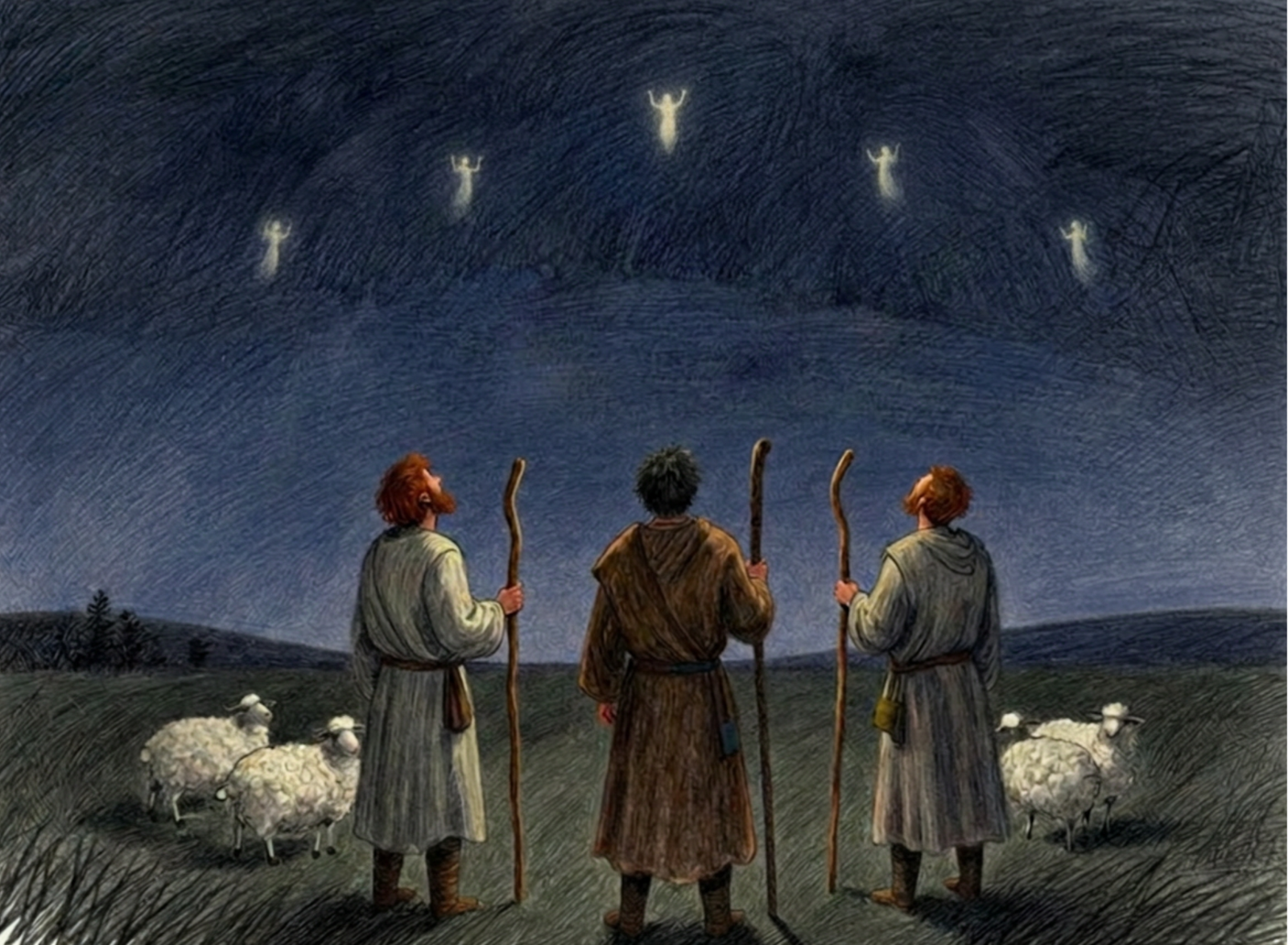
The carol is of French origin, originally titled “Les anges dans nos campagnes” (The Angels in Our Countryside), with its roots believed to trace back to the Languedoc region of France. According to tradition, shepherds in the hills of southern France had a Christmas Eve custom of calling to one another, singing “Gloria in Excelsis Deo” from their own hillsides — and the tune that emerged from that tradition may have roots in a late Medieval Latin chorale.
Its first known publication was in 1805, in a book of French carols by Révérend Père Roche, under the title “J’Entends, là sur ces collines.” No author was credited, and it’s unclear whether Roche wrote it or simply collected it. It was also published in North America — in a Nouveau recueil de cantiques for the Diocese of Quebec — as early as 1819.
The original French hymn was arranged in eight stanzas in a dialogue form, alternating between shepherds and the women of Bethlehem, with all voices joining together in the final stanzas.
The English Translation
“Angels We Have Heard on High” as English speakers know it today was a paraphrase written in 1862 by James Chadwick, the Roman Catholic Bishop of Hexham and Newcastle in northeast England. Chadwick’s lyrics were original in some sections and loosely translated from the French in others, possibly drawn from multiple versions of the French carol. The English version was adapted for use by Henri Hemy and published in Crown of Jesus Music in 1862.
The Gloria Tune
The hymn is most commonly sung today to a tune called “Gloria,” arranged by American organist Edward Shippen Barnes. The popularity of the carol owes a great deal to its refrain — all those cascading phrases in which human beings imitate the angels’ chorus.
The Biblical Connection
The refrain “Gloria in excelsis Deo” is taken directly from Luke 2:14 — the canticle of the angels’ song — one of the most famous verses in the Christmas story. The entire hymn is inspired by Luke 2:6–20. The words mean “Glory to God in the highest” in Latin, the proclamation the angels make when they appear to the shepherds.
Into the Mainstream
The version that became popular worldwide was published in 1916 in the book Carols Old and Carols New, and the Barnes arrangement is believed to have first appeared around 1937 in the New Church Hymnal. The carol first entered Methodist hymnals in 1935, and the familiar phrasing “Angels we have heard on high” was standardized in the 1966 Methodist Hymnal.